Progressive Overload App: Hardy Adds the Weight for You
A progressive overload app should tell you what to lift next, not just store what you lifted. Hardy is free on iPhone and Android. It works out your next weight from the rule in your routine, and you approve each change.


Routines lifters run on Hardy
There are three common ways to add load over time, and Hardy runs all three. Pick the one that fits where you are. Each link opens the full routine with every workout listed.
Add weight every session
Finish all your sets and the next session is 5 lbs (2.5 kg) heavier. Best for your first months of lifting.
5x5 Workout
3 days a week
Five sets of five on squat, bench, row, press and deadlift. Three missed sessions in a row drop the weight by 10%.
Open routineGreyskull LP
3 days a week
Two sets of five and a last set for max reps. A big last set earns a double jump.
Open routineAdd reps, then weight
Work inside a rep range, such as 8 to 12. Reach the top of the range on every set and the weight goes up.
Reddit PPL
6 days a week
Push, pull and legs twice a week. The big lifts add weight each session and the accessories add reps first.
Open routineDumbbell Only Workout
3 days a week
Full body with a pair of dumbbells. Dumbbell jumps are big, so reps carry most of the progress.
Open routineAdd weight every cycle
Sets are a percentage of a Training Max. The Training Max goes up a little after each cycle of three or four weeks.
5/3/1 Boring But Big
4 days a week, 4-week cycle
Main 5/3/1 sets, then 5×10 of the same lift at 50%. Built for lifters past the beginner stage.
Open routine5/3/1 for Beginners
3 days a week, 3-week cycle
Two main lifts per full-body day. The usual next step after a 5x5 program stalls.
Open routineNot sure which one fits? 5/3/1 vs 5x5 explains when to move from the first group to the third.
Running 5/3/1 already? The 531 app page covers every template.
How Hardy tracks progressive overload
The example below is the 5x5 Workout in lbs. The other routines work the same way with a different rule.
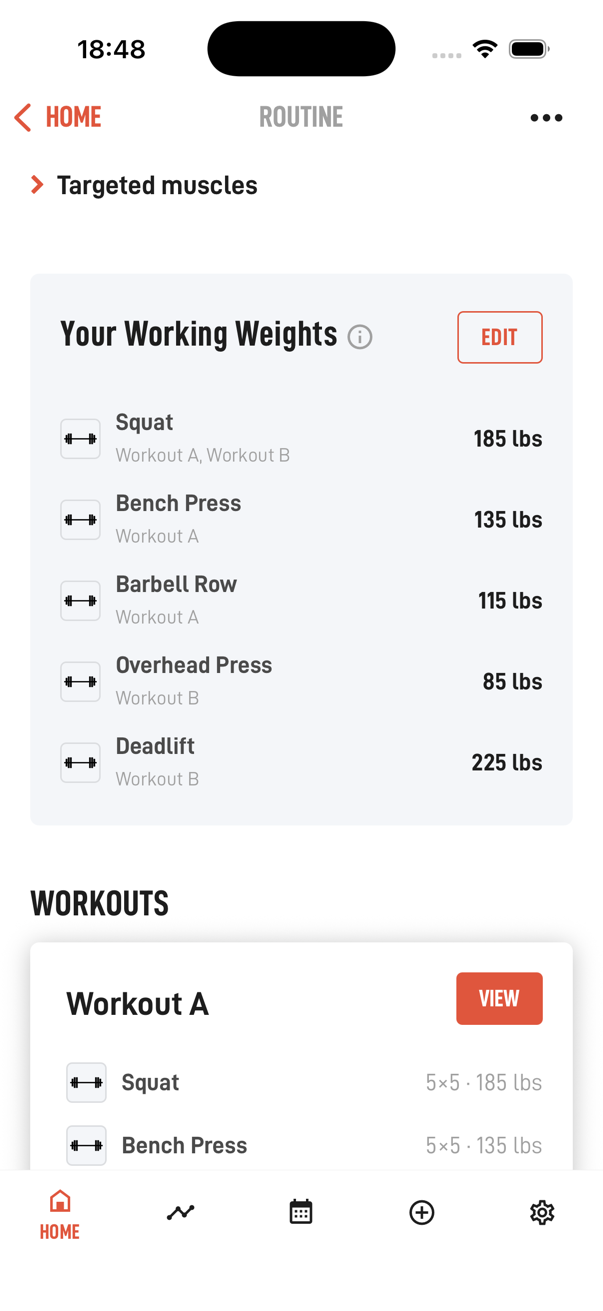
1. Set your starting weights once
Open the routine and enter the weight you lift today for each exercise. Hardy keeps one working weight per lift. If you are not sure, leave it empty and Hardy takes the weight from your first session.
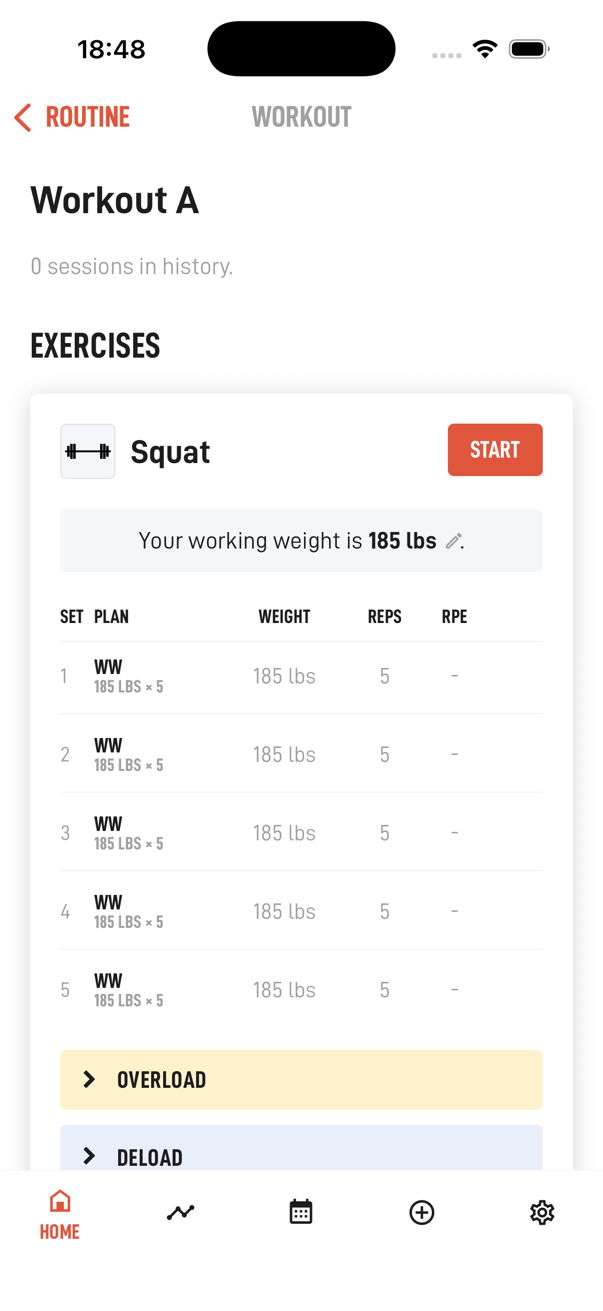
2. Every set shows the weight to lift
Each workout lists its sets with the weight already worked out. It is rounded to the plates you own, in lbs or kg. You never do the math between sets.
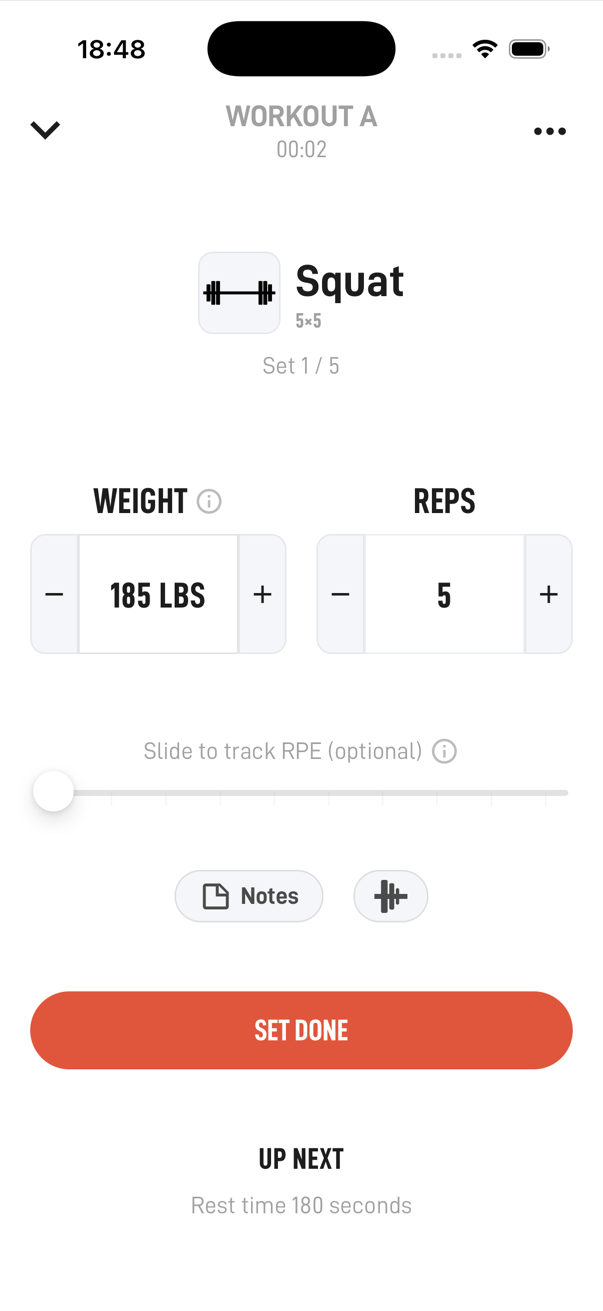
3. Log the set with one tap
The tracker shows one set at a time with its target weight and reps. Tap Set Done, or change the reps if you missed some. Hardy marks a set as failed when you lift less weight or fewer reps than planned.
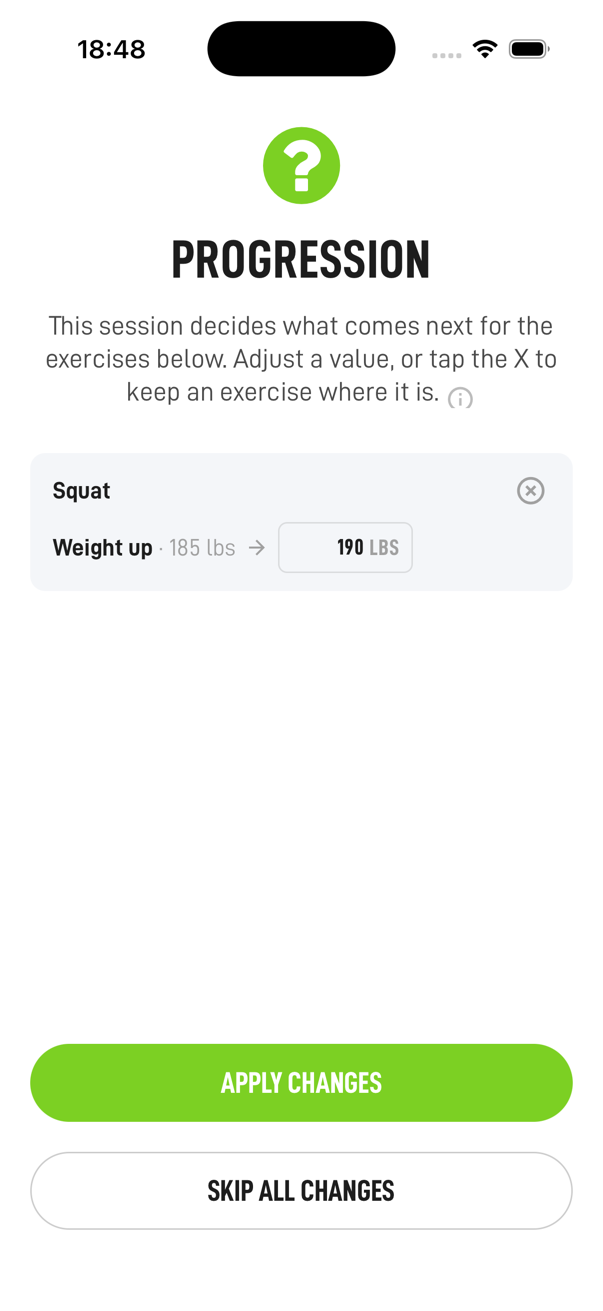
4. Review the next weight
After the workout, Hardy applies the rule in your routine and proposes the new weight. You apply it, change it or skip it. Nothing changes without you seeing it first.
Want to do it by hand first? How to track progressive overload walks through the log, the rule and a 12-week example.
Still comparing apps? See the best workout apps for lifting weights.
What a progressive overload tracker needs to show
A progressive overload tracker is only useful if it changes what you do in the gym. These five things separate a tracker from a notebook. Hardy does all five.
| Next weight | The app works out what to lift next from a written rule. You should not have to remember it. |
|---|---|
| Plate rounding | Every weight is rounded to the plates and dumbbells you have, in lbs or kg. |
| Failed sets | A missed rep is noticed, so the weight holds or drops when the rule says so. |
| Trend chart | Estimated 1RM, heaviest weight and total weight lifted are charted per exercise. |
| Your review | Every weight change is shown to you first. You apply it, edit it or skip it. |
What you get before you download
| Rules | Add weight after a good session, drop it after missed ones, add reps before weight, or raise a Training Max each cycle |
|---|---|
| Routines | Ready routines for each way of progressing, and an editor to build your own or change any rule |
| Units | lbs or kg, with your own smallest step per barbell, dumbbell, kettlebell or machine |
| History | Every set of every workout, with charts per exercise |
| Price | Every routine on this page is free to follow. The free plan includes three routines you create yourself, and Hardy PRO removes that cap |
| Platforms | iPhone and Android app, with routine pages and calculators on the web |
Want the numbers first? The 1RM calculator estimates your max from any hard set. The plate calculator shows what to load.
Frequently asked questions
Is there a free progressive overload app?
Yes. Hardy is free on iPhone and Android, and every routine on this page is free to add and follow. The free plan also includes three routines you create yourself.
How does the app know when to add weight?
Each exercise in a routine carries a rule. For example: after one session with every rep done, add 5 lbs (2.5 kg). Hardy checks the rule when you finish the workout and shows you the new weight to approve.
What happens when I miss reps?
Hardy counts the session as missed for that lift and keeps the weight the same. If the routine has a rule for it, several missed sessions in a row lower the weight, often by 10%. You review that change too.
Is a spreadsheet enough as a progressive overload tracker?
A spreadsheet can store your sets, and that is a good start. It will not round to your plates, time your rest or tell you the next weight in the gym. An app does the same job with less typing.
Can I use my own routine?
Yes. Build a routine in the app or on the web and set a rule on any exercise. You can also copy any routine above and change its exercises, sets and rules.
Does it work in lbs and kg?
Yes. Choose lbs or kg in the app. Every weight is rounded to that unit and to your smallest step, 5 lbs or 2.5 kg for a barbell by default.
Start with one routine
Pick a routine above, download Hardy and enter the weights you lift today. Your first workout is ready before you leave the gym car park.
%20--%3e%3csvg%20version='1.1'%20id='Layer_1'%20xmlns='http://www.w3.org/2000/svg'%20xmlns:xlink='http://www.w3.org/1999/xlink'%20x='0px'%20y='0px'%20viewBox='0%200%20703%20223.4'%20style='enable-background:new%200%200%20703%20223.4;'%20xml:space='preserve'%3e%3cstyle%20type='text/css'%3e%20.st0{fill:%23FFFFFF;}%20.st1{opacity:0.1;fill:url(%23SVGID_1_);}%20.st2{opacity:0.1;fill:url(%23SVGID_2_);}%20.st3{opacity:0.1;fill:url(%23SVGID_3_);}%20.st4{opacity:0.1;fill:url(%23SVGID_4_);}%20%3c/style%3e%3ctitle%3esquare-logoAsset%202%3c/title%3e%3cg%20id='Layer_2_1_'%3e%3cg%20id='Layer_1-2'%3e%3cpath%20class='st0'%20d='M185,116.1c0-33.9,23.7-63.1,59.5-63.1c12.3,0,22,4.3,28.5,10.2v-7.5h36.5v120.9h-36.5v-7.7%20c-6.5,6-16.2,10.4-28.5,10.4C208.7,179.2,185,149.9,185,116.1z%20M273,134.4v-37c-5.1-6.5-11.6-11.4-23-11.4%20c-16.4,0-27.3,13.8-27.3,30s10.9,30,27.3,30C261.5,146.1,268,141.2,273,134.4L273,134.4z'/%3e%3cpath%20class='st0'%20d='M339.6,55.6h36.5v13.5c3.9-8.5,14.5-15,26.8-15c5,0,10,0.8,14.8,2.4l-5.6,34.1c-1-0.7-5.1-1.4-10.2-1.4%20c-8.5,0-19.8,2.4-25.9,10.9v76.4h-36.5V55.6z'/%3e%3cpath%20class='st0'%20d='M423.7,116.1c0-33.9,23.7-63.1,59.5-63.1c12.3,0,22,4.3,28.5,10.2V0h36.5v176.5h-36.5v-7.7%20c-6.5,6-16.2,10.4-28.5,10.4C447.4,179.2,423.7,149.9,423.7,116.1z%20M511.7,134.4v-37c-5.1-6.5-11.6-11.4-23-11.4%20c-16.5,0-27.3,13.8-27.3,30s10.9,30,27.3,30C500.1,146.1,506.6,141.2,511.7,134.4L511.7,134.4z'/%3e%3cpath%20class='st0'%20d='M590.1,223.4l23.5-53.9L563.2,55.6h39.9l30,74.7l29.7-74.7H703l-73.5,167.8H590.1z'/%3e%3cpolygon%20class='st0'%20points='168.5,72.1%20157.3,72.1%20157.3,4.8%20118.8,4.8%20118.8,72.1%2049.7,72.1%2049.7,4.8%2011.2,4.8%2011.2,72.1%200,72.1%200,108.6%2011.2,108.6%2011.2,176.5%2049.7,176.5%2049.7,108.6%20118.8,108.6%20118.8,176.5%20157.3,176.5%20157.3,108.6%20168.5,108.6%20'/%3e%3clinearGradient%20id='SVGID_1_'%20gradientUnits='userSpaceOnUse'%20x1='0'%20y1='135.685'%20x2='11.25'%20y2='135.685'%20gradientTransform='matrix(1%200%200%20-1%200%20226)'%3e%3cstop%20offset='0'%20style='stop-color:%23000000;stop-opacity:0'/%3e%3cstop%20offset='1'%20style='stop-color:%23000000'/%3e%3c/linearGradient%3e%3crect%20y='72.1'%20class='st1'%20width='11.2'%20height='36.5'/%3e%3clinearGradient%20id='SVGID_2_'%20gradientUnits='userSpaceOnUse'%20x1='168.54'%20y1='135.685'%20x2='157.29'%20y2='135.685'%20gradientTransform='matrix(1%200%200%20-1%200%20226)'%3e%3cstop%20offset='0'%20style='stop-color:%23000000;stop-opacity:0'/%3e%3cstop%20offset='1'%20style='stop-color:%23000000'/%3e%3c/linearGradient%3e%3crect%20x='157.3'%20y='72.1'%20class='st2'%20width='11.2'%20height='36.5'/%3e%3clinearGradient%20id='SVGID_3_'%20gradientUnits='userSpaceOnUse'%20x1='105.08'%20y1='135.685'%20x2='118.85'%20y2='135.685'%20gradientTransform='matrix(1%200%200%20-1%200%20226)'%3e%3cstop%20offset='0'%20style='stop-color:%23000000;stop-opacity:0'/%3e%3cstop%20offset='1'%20style='stop-color:%23000000'/%3e%3c/linearGradient%3e%3crect%20x='105.1'%20y='72.1'%20class='st3'%20width='13.8'%20height='36.5'/%3e%3clinearGradient%20id='SVGID_4_'%20gradientUnits='userSpaceOnUse'%20x1='63.11'%20y1='135.685'%20x2='49.7'%20y2='135.685'%20gradientTransform='matrix(1%200%200%20-1%200%20226)'%3e%3cstop%20offset='0'%20style='stop-color:%23000000;stop-opacity:0'/%3e%3cstop%20offset='1'%20style='stop-color:%23000000'/%3e%3c/linearGradient%3e%3crect%20x='49.7'%20y='72.1'%20class='st4'%20width='13.4'%20height='36.5'/%3e%3c/g%3e%3c/g%3e%3c/svg%3e)
 /r/HardyApp