Every strength standards table on the internet is built from the same thing: people typing their best lifts into a form. Hardy has something different. Lifters log every set in the app as they train, so we can watch strength change over time instead of guessing from a snapshot. This report analyses 5.8 million finished sets from 368,505 workouts logged by 10,407 lifters between 2021-03-06 and 2026-09-02.
It answers the questions lifters actually ask: how many people can bench 225 and how long it takes, how much stronger you should expect to be after a year, and what a typical lifter who tracks their training actually lifts.
A 2-plate bench (100 kg / 225 lb) is rarer than gym talk suggests: of lifters who started below it and were still logging a year later, 10% had reached it within 12 months, and 15% within two years. Starting strength dominates: 22% of those who began at 1 plate or more got there within a year, against 1% of those who began below 1 plate.
A 3-plate squat (140 kg / 315 lb): 7% of lifters who started below it reached it within 12 months of logging, 11% within 24 months.
A 4-plate deadlift (180 kg / 405 lb): 4% within 12 months, 6% within 24 months, among lifters who started below it.
After 12 months of logging, the median bench press estimated 1RM was up 7.6 kg (17 lb) (11%), and 29% of lifters were no stronger than when they started.
The intermediate stall is real: lifters who started with a 100 to 140 kg bench added a median of 1.9 kg (4 lb) in a year, and 44% of them made no progress at all.
The median lifter's best estimated bench press is 77.4 kg (171 lb); only 12% have ever benched 100 kg or more for a rep.
The typical workout is 48.8 minutes, 16 sets across 4 exercises, and the median lifter trains twice in an active week.
How long it takes to reach 1, 2, 3 and 4 plates
Plate milestones are how lifters talk about strength: a 2-plate bench, a 3-plate squat, a 4-plate deadlift. For every lifter we found the first session of each lift, checked they started below the milestone, and then tracked when (and whether) the weight was actually lifted for at least one rep. Each curve shows the share of lifters who had reached the milestone after N months of logged training, counting only lifters who were still logging at that point.
Bench Press: share of lifters who had reached each plate milestone, by months of logged training
1 plate (60 kg / 135 lb)
2 plates (100 kg / 225 lb)
3 plates (140 kg / 315 lb)
Only lifters who started below the milestone and were still logging at that month are counted. A milestone counts when the weight was actually lifted for at least one rep, not estimated.
View the data table
Months since first logged session
1 plate (60 kg / 135 lb)
2 plates (100 kg / 225 lb)
3 plates (140 kg / 315 lb)
1
10%
2%
0%
2
21%
4%
0%
3
27%
5%
0%
4
30%
7%
0%
5
31%
7%
0%
6
34%
8%
0%
7
36%
9%
1%
8
37%
9%
1%
9
38%
10%
1%
10
40%
10%
1%
11
41%
10%
1%
12
42%
10%
1%
13
43%
11%
1%
14
44%
12%
1%
15
45%
12%
1%
16
45%
12%
1%
17
47%
12%
1%
18
48%
13%
1%
19
48%
12%
1%
20
48%
12%
2%
21
50%
13%
2%
22
51%
13%
2%
23
52%
14%
1%
24
54%
15%
1%
25
55%
15%
1%
26
55%
16%
1%
27
57%
17%
1%
28
59%
17%
1%
29
61%
19%
1%
30
61%
20%
1%
31
58%
21%
1%
32
61%
22%
1%
33
60%
22%
2%
34
60%
23%
2%
35
62%
25%
2%
36
65%
27%
3%
Squat: share of lifters who had reached each plate milestone, by months of logged training
1 plate (60 kg / 135 lb)
2 plates (100 kg / 225 lb)
3 plates (140 kg / 315 lb)
4 plates (180 kg / 405 lb)
Only lifters who started below the milestone and were still logging at that month are counted. A milestone counts when the weight was actually lifted for at least one rep, not estimated.
View the data table
Months since first logged session
1 plate (60 kg / 135 lb)
2 plates (100 kg / 225 lb)
3 plates (140 kg / 315 lb)
4 plates (180 kg / 405 lb)
1
14%
5%
1%
0%
2
25%
9%
2%
0%
3
32%
14%
3%
0%
4
36%
16%
4%
0%
5
40%
18%
4%
1%
6
42%
19%
5%
1%
7
44%
21%
5%
1%
8
45%
21%
5%
1%
9
47%
23%
6%
1%
10
49%
23%
6%
1%
11
50%
25%
6%
1%
12
52%
26%
7%
2%
13
53%
27%
7%
2%
14
53%
28%
7%
2%
15
55%
29%
8%
2%
16
56%
30%
8%
2%
17
57%
31%
8%
2%
18
57%
31%
9%
2%
19
58%
32%
9%
2%
20
57%
32%
9%
2%
21
60%
33%
10%
2%
22
61%
33%
10%
2%
23
61%
35%
11%
2%
24
62%
35%
11%
2%
25
62%
36%
11%
2%
26
65%
37%
12%
2%
27
67%
39%
12%
2%
28
66%
38%
13%
2%
29
68%
38%
13%
2%
30
74%
39%
15%
2%
31
72%
40%
16%
2%
32
70%
40%
17%
1%
33
67%
42%
17%
2%
34
71%
41%
17%
1%
35
45%
19%
2%
36
42%
26%
3%
Deadlift: share of lifters who had reached each plate milestone, by months of logged training
1 plate (60 kg / 135 lb)
2 plates (100 kg / 225 lb)
3 plates (140 kg / 315 lb)
4 plates (180 kg / 405 lb)
Only lifters who started below the milestone and were still logging at that month are counted. A milestone counts when the weight was actually lifted for at least one rep, not estimated.
View the data table
Months since first logged session
1 plate (60 kg / 135 lb)
2 plates (100 kg / 225 lb)
3 plates (140 kg / 315 lb)
4 plates (180 kg / 405 lb)
1
18%
8%
2%
1%
2
31%
16%
4%
1%
3
38%
21%
6%
2%
4
42%
25%
9%
2%
5
45%
26%
10%
2%
6
49%
28%
11%
2%
7
50%
30%
12%
3%
8
51%
32%
13%
3%
9
51%
33%
13%
3%
10
53%
34%
14%
3%
11
54%
35%
15%
3%
12
55%
36%
15%
4%
13
57%
37%
15%
4%
14
58%
38%
16%
4%
15
62%
39%
17%
4%
16
64%
39%
17%
4%
17
66%
41%
17%
5%
18
66%
42%
18%
5%
19
69%
42%
18%
5%
20
70%
45%
18%
5%
21
72%
46%
19%
6%
22
73%
48%
20%
5%
23
73%
50%
20%
5%
24
72%
51%
22%
6%
25
75%
52%
22%
6%
26
75%
52%
22%
6%
27
81%
54%
24%
6%
28
84%
54%
25%
6%
29
87%
55%
26%
6%
30
90%
57%
27%
7%
31
57%
29%
7%
32
56%
31%
7%
33
56%
33%
8%
34
58%
33%
10%
35
60%
35%
7%
36
36%
8%
Overhead Press: share of lifters who had reached each plate milestone, by months of logged training
Only lifters who started below the milestone and were still logging at that month are counted. A milestone counts when the weight was actually lifted for at least one rep, not estimated.
View the data table
Months since first logged session
1 plate (60 kg / 135 lb)
1
3%
2
6%
3
7%
4
9%
5
10%
6
11%
7
12%
8
12%
9
13%
10
13%
11
14%
12
14%
13
15%
14
16%
15
15%
16
15%
17
15%
18
16%
19
16%
20
16%
21
17%
22
17%
23
17%
24
19%
25
19%
26
20%
27
21%
28
23%
29
24%
30
24%
31
26%
32
27%
33
30%
34
30%
35
33%
36
33%
Milestones are counted from the first logged session of that lift. Only lifters who started below the milestone are included; the 12- and 24-month columns only count lifters who were still logging at that point. The median is shown only where at least 50 lifters reached the milestone, and it is a survivor statistic: most who got there started within one plate of it.
For each lifter we took the best estimated 1RM in their first month of logging a lift and compared it to the best estimated 1RM in the window around month 1, 3, 6 and 12. Only lifters with a session in that window are counted, so these are people who kept training. The bars show the median gain; the tables show how wide the spread is.
Bench Press: median estimated 1RM gain by starting strength
Started at 0-40 kg
Started at 40-60 kg
Started at 60-100 kg
Started at 100-140 kg
Estimated 1RM uses the Epley formula on the best set of each session (10 reps or fewer). Gains are relative to the lifter's first month.
View the data table
Months of logged training
Started at 0-40 kg
Started at 40-60 kg
Started at 60-100 kg
Started at 100-140 kg
1 mo
2.9 kg
3.6 kg
2.9 kg
2.2 kg
3 mo
6.5 kg
7.5 kg
5.2 kg
2 kg
6 mo
7.5 kg
9.7 kg
6.2 kg
2.6 kg
12 mo
11.1 kg
11 kg
8.4 kg
1.9 kg
Bench Press: estimated 1RM change after N months, all starting levels. Interquartile range shows the middle half of lifters.
After
Lifters
Median gain
Middle 50%
Median gain %
No gain or lost strength
1 month
4,138
2.9 kg (6 lb)
0 to 7.3 kg
4%
33%
3 months
2,327
5.2 kg (11 lb)
0 to 11.7 kg
7%
29%
6 months
1,487
6.2 kg (14 lb)
0 to 14.4 kg
9%
29%
12 months
835
7.6 kg (17 lb)
-0.2 to 17.5 kg
11%
29%
Squat: median estimated 1RM gain by starting strength
Started at 0-40 kg
Started at 40-60 kg
Started at 60-100 kg
Started at 100-140 kg
Started at 140-180 kg
Estimated 1RM uses the Epley formula on the best set of each session (10 reps or fewer). Gains are relative to the lifter's first month.
View the data table
Months of logged training
Started at 0-40 kg
Started at 40-60 kg
Started at 60-100 kg
Started at 100-140 kg
Started at 140-180 kg
1 mo
5.7 kg
6 kg
5.3 kg
4.8 kg
1.5 kg
3 mo
11.7 kg
13 kg
8.8 kg
6.9 kg
2.4 kg
6 mo
17.3 kg
17.5 kg
10.6 kg
8.4 kg
2.1 kg
12 mo
22.4 kg
12 kg
8.8 kg
Squat: estimated 1RM change after N months, all starting levels. Interquartile range shows the middle half of lifters.
After
Lifters
Median gain
Middle 50%
Median gain %
No gain or lost strength
1 month
3,515
5.1 kg (11 lb)
0 to 11 kg
6%
30%
3 months
1,965
8.5 kg (19 lb)
0 to 18.1 kg
10%
26%
6 months
1,190
10.9 kg (24 lb)
0 to 22.1 kg
12%
27%
12 months
702
11.7 kg (26 lb)
-2.9 to 27 kg
13%
31%
Deadlift: median estimated 1RM gain by starting strength
Started at 0-40 kg
Started at 40-60 kg
Started at 60-100 kg
Started at 100-140 kg
Started at 140-180 kg
Estimated 1RM uses the Epley formula on the best set of each session (10 reps or fewer). Gains are relative to the lifter's first month.
View the data table
Months of logged training
Started at 0-40 kg
Started at 40-60 kg
Started at 60-100 kg
Started at 100-140 kg
Started at 140-180 kg
1 mo
6 kg
6.2 kg
5.8 kg
5.1 kg
2.9 kg
3 mo
11.6 kg
16.2 kg
12.9 kg
9.8 kg
8 kg
6 mo
21.2 kg
17.9 kg
11.7 kg
6.3 kg
12 mo
22.8 kg
12.5 kg
3.3 kg
Deadlift: estimated 1RM change after N months, all starting levels. Interquartile range shows the middle half of lifters.
After
Lifters
Median gain
Middle 50%
Median gain %
No gain or lost strength
1 month
3,054
5.3 kg (12 lb)
0 to 12.1 kg
5%
31%
3 months
1,640
10.9 kg (24 lb)
0.5 to 21.2 kg
11%
24%
6 months
992
14.3 kg (32 lb)
1.2 to 27.4 kg
14%
24%
12 months
563
17.5 kg (39 lb)
0 to 34.5 kg
16%
26%
Overhead Press: median estimated 1RM gain by starting strength
Started at 0-40 kg
Started at 40-60 kg
Started at 60-100 kg
Estimated 1RM uses the Epley formula on the best set of each session (10 reps or fewer). Gains are relative to the lifter's first month.
View the data table
Months of logged training
Started at 0-40 kg
Started at 40-60 kg
Started at 60-100 kg
1 mo
2.7 kg
2.2 kg
1.1 kg
3 mo
4.7 kg
3.5 kg
0.5 kg
6 mo
5.8 kg
4.5 kg
0 kg
12 mo
7.9 kg
5 kg
-0.2 kg
Overhead Press: estimated 1RM change after N months, all starting levels. Interquartile range shows the middle half of lifters.
After
Lifters
Median gain
Middle 50%
Median gain %
No gain or lost strength
1 month
2,732
2.2 kg (5 lb)
0 to 5.7 kg
5%
36%
3 months
1,456
3.3 kg (7 lb)
0 to 8.8 kg
8%
30%
6 months
837
4.5 kg (10 lb)
-0.5 to 10 kg
10%
31%
12 months
457
5.3 kg (12 lb)
-1.4 to 11.5 kg
13%
31%
What people actually log
Most logged exercises, by share of all finished setsView the data table
Share of sets
bench press
10%
squat
8%
overhead press
6%
deadlift
5%
barbell row
3%
lat pulldown
2%
lateral raise
2%
incline bench press
2%
leg curl
2%
tricep pushdown
1%
seated cable row
1%
leg extension
1%
hammer curl
1%
Cable crunch
1%
curl
1%
Where the sets go: share of sets by primary muscle groupView the data table
Share of sets
glutes
16%
chest
15%
lats
12%
quads
11%
hamstrings
8%
front delts
7%
biceps
6%
triceps
6%
lower back
5%
side delts
3%
abs
3%
rear delts
2%
forearms
2%
calves
2%
traps
1%
obliques
0%
Workout statistic
Value
Median workout length
48.8 min
Middle 50% of workouts
34.4 to 66.5 min
Median sets per workout
16
Median exercises per workout
4
Median tonnage per workout
4,330 kg
Median workouts per active week
2
Active weeks with 1 workout
32%
Active weeks with 3 workouts
21%
Active weeks with 5+ workouts
7%
Reps per set on weighted exercisesView the data table
Reps
Share
1-3
5%
4-5
20%
6-8
20%
9-12
44%
13-20
9%
21+
1%
Rest between sets, where a rest timer was usedView the data table
Rest
Share
<60s
27%
60-89s
12%
90-119s
21%
120-179s
23%
180-299s
13%
300s+
5%
RPE logged per set, where RPE was recorded
RPE was recorded on 11% of finished sets.
View the data table
RPE
Share
6
12%
6.5
3%
7
11%
7.5
4%
8
18%
8.5
8%
9
18%
9.5
9%
10
17%
Which days people train
Workout dates are recorded in UTC, so a late-evening session in the Americas can land on the next day.
View the data table
Day of week
Share
Mon
17%
Tue
17%
Wed
16%
Thu
15%
Fri
15%
Sat
11%
Sun
9%
How much a typical lifter lifts
These are not strength standards by bodyweight. Hardy does not know anyone's bodyweight or sex, and its users are self-selected people who track their training. What the table shows is the distribution of best estimated 1RMs across everyone who logged the lift in at least 3 sessions, which is a useful reality check next to the usual "beginner / intermediate / advanced" labels.
Best estimated 1RM per lifter, across everyone who logged the lift in at least 3 sessions. These are app users who track their training, not the general population.
Lift
Lifters
Bottom 10%
25th percentile
Median
75th percentile
Top 10%
Top 1%
Bench Press
6,500
38.5 kg (85 lb)
57.5 kg (127 lb)
77.4 kg (171 lb)
97.7 kg (215 lb)
115.2 kg (254 lb)
151.5 kg (334 lb)
Squat
5,931
47.5 kg (105 lb)
69.6 kg (153 lb)
93.3 kg (206 lb)
120.7 kg (266 lb)
147.6 kg (325 lb)
204 kg (450 lb)
Deadlift
5,247
57 kg (126 lb)
79.4 kg (175 lb)
110.5 kg (244 lb)
140.7 kg (310 lb)
171.5 kg (378 lb)
226.7 kg (500 lb)
Overhead Press
4,582
26.5 kg (58 lb)
37.3 kg (82 lb)
49.1 kg (108 lb)
60.9 kg (134 lb)
71.4 kg (157 lb)
98.1 kg (216 lb)
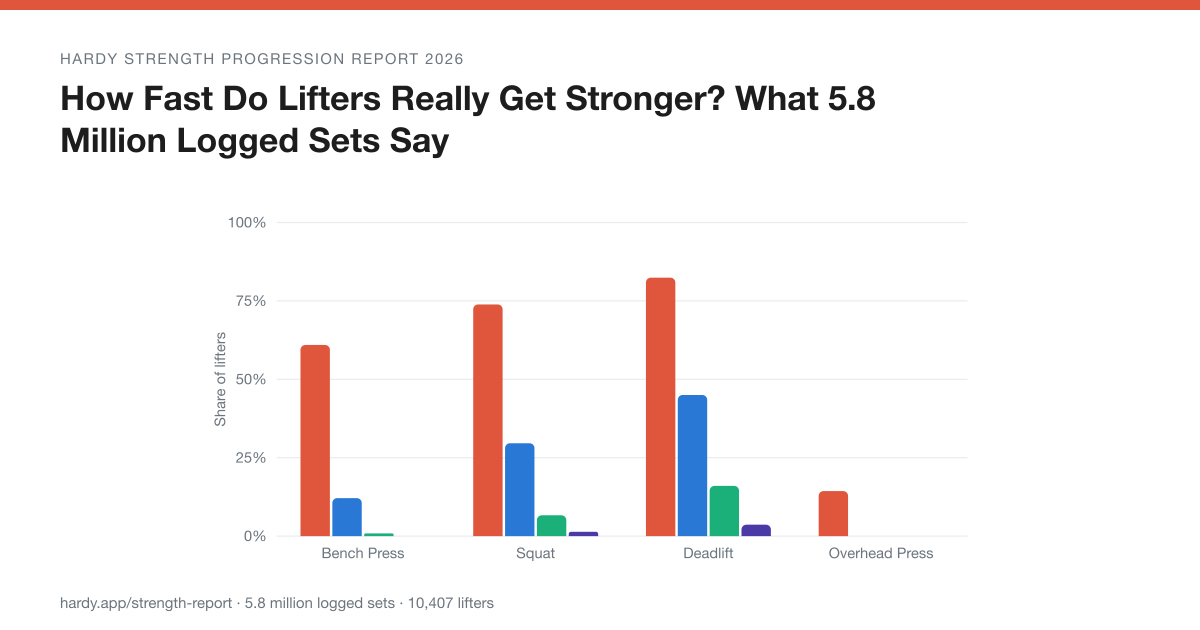
Share of lifters who have lifted each plate milestone for at least one rep
1 plate (60 kg)
2 plates (100 kg)
3 plates (140 kg)
4 plates (180 kg)
View the data table
1 plate (60 kg)
2 plates (100 kg)
3 plates (140 kg)
4 plates (180 kg)
Bench Press
61%
12%
1%
Squat
74%
30%
7%
1%
Deadlift
82%
45%
16%
4%
Overhead Press
14%
Methodology
The dataset is every workout logged in the Hardy app between 2021-03-06 and 2026-09-02: 368,505 workouts and 5,843,507 finished sets from 10,407 lifters. All numbers are aggregates. No individual workout, lifter, or account is identifiable.
A workout counts if it lasted between 5 minutes and 6 hours. Shorter and longer sessions are almost always accidental starts or forgotten timers.
A set counts as finished if it has at least 1 and at most 50 logged reps. Sets that were planned but never performed are excluded.
Progression analysis uses lifters with at least 3 qualifying workouts (7,667 lifters) and the barbell bench press, squat, deadlift and overhead press as logged against the built-in exercises.
Estimated 1RM is Epley (weight × (1 + reps / 30)) on the best set of a session, using sets of 10 reps or fewer. Sets implying an estimated 1RM above 500 kg are dropped as entry errors.
Plate milestones are 60 / 100 / 140 / 180 kg for lifters who use kilograms and 135 / 225 / 315 / 405 lb for lifters who use pounds. A milestone counts on the first session where that weight was lifted for at least one rep.
Time-to-milestone curves only include lifters who started below the milestone (best set in their first two weeks) and were still logging at the month shown, so nobody is counted as failing just because they stopped using the app.
Any group with fewer than 50 lifters is suppressed.
Hardy users are people who chose a strength tracking app and kept logging. They are stronger and more consistent than the average gym-goer, and the report does not know anyone's bodyweight, age or sex. Read the numbers as "people who track their lifting", not as population strength standards.
Longer than most people expect. Of lifters who started below 225 lb / 100 kg and kept logging for a year, 10% had benched it within 12 months, and 15% of those still logging at two years had done it by then. Starting from 1 plate or more the one-year odds were 22%, starting below 1 plate 1%. The bench press chapter answers how many people can bench 225 and has the full curves by starting strength.
What is the average bench press?
Among Hardy users who logged the bench press in at least 3 sessions, the median best estimated 1RM is 77.4 kg (171 lb). A quarter are below 57.5 kg (127 lb) and the top 10% are above 115.2 kg (254 lb). 12% have benched 100 kg or more for at least one rep. These are people who track their training, so they skew stronger than the average gym-goer.
What is the average squat and deadlift?
The median best estimated 1RM among Hardy users is 93.3 kg (206 lb) for the squat and 110.5 kg (244 lb) for the deadlift. The top 10% squat more than 147.6 kg (325 lb) and deadlift more than 171.5 kg (378 lb). 16% of deadlifters have pulled 140 kg / 3 plates for a rep, and 7% of squatters have squatted it.
How much stronger should I be after a year of lifting?
Across all starting levels, the median Hardy user added 7.6 kg (17 lb) to their estimated bench press 1RM after 12 months of logging, an increase of 11%. The spread is wide: the middle half ranged from -0.2 kg to 17.5 kg, and 29% made no progress at all. Lifters who started weakest gained the most; see the charts by starting strength above.
Where does this data come from?
Anonymised, aggregated workout logs from the Hardy strength training app: 5,843,507 finished sets across 368,505 workouts by 10,407 lifters. No individual is identifiable, groups under 50 lifters are suppressed, and the full method is described in the methodology section. The aggregate data is downloadable as CSV.
Hardy tracks every set and works out your next weights for you, so your own progression curve builds itself. Run a proven program or build your own.
Cite this reportHardy (2026). How Fast Do Lifters Really Get Stronger? What 5.8 Million Logged Sets Say. Hardy Strength Progression Report. https://hardy.app/strength-report
%20--%3e%3csvg%20version='1.1'%20id='Layer_1'%20xmlns='http://www.w3.org/2000/svg'%20xmlns:xlink='http://www.w3.org/1999/xlink'%20x='0px'%20y='0px'%20viewBox='0%200%20703%20223.4'%20style='enable-background:new%200%200%20703%20223.4;'%20xml:space='preserve'%3e%3cstyle%20type='text/css'%3e%20.st0{fill:%23FFFFFF;}%20.st1{opacity:0.1;fill:url(%23SVGID_1_);}%20.st2{opacity:0.1;fill:url(%23SVGID_2_);}%20.st3{opacity:0.1;fill:url(%23SVGID_3_);}%20.st4{opacity:0.1;fill:url(%23SVGID_4_);}%20%3c/style%3e%3ctitle%3esquare-logoAsset%202%3c/title%3e%3cg%20id='Layer_2_1_'%3e%3cg%20id='Layer_1-2'%3e%3cpath%20class='st0'%20d='M185,116.1c0-33.9,23.7-63.1,59.5-63.1c12.3,0,22,4.3,28.5,10.2v-7.5h36.5v120.9h-36.5v-7.7%20c-6.5,6-16.2,10.4-28.5,10.4C208.7,179.2,185,149.9,185,116.1z%20M273,134.4v-37c-5.1-6.5-11.6-11.4-23-11.4%20c-16.4,0-27.3,13.8-27.3,30s10.9,30,27.3,30C261.5,146.1,268,141.2,273,134.4L273,134.4z'/%3e%3cpath%20class='st0'%20d='M339.6,55.6h36.5v13.5c3.9-8.5,14.5-15,26.8-15c5,0,10,0.8,14.8,2.4l-5.6,34.1c-1-0.7-5.1-1.4-10.2-1.4%20c-8.5,0-19.8,2.4-25.9,10.9v76.4h-36.5V55.6z'/%3e%3cpath%20class='st0'%20d='M423.7,116.1c0-33.9,23.7-63.1,59.5-63.1c12.3,0,22,4.3,28.5,10.2V0h36.5v176.5h-36.5v-7.7%20c-6.5,6-16.2,10.4-28.5,10.4C447.4,179.2,423.7,149.9,423.7,116.1z%20M511.7,134.4v-37c-5.1-6.5-11.6-11.4-23-11.4%20c-16.5,0-27.3,13.8-27.3,30s10.9,30,27.3,30C500.1,146.1,506.6,141.2,511.7,134.4L511.7,134.4z'/%3e%3cpath%20class='st0'%20d='M590.1,223.4l23.5-53.9L563.2,55.6h39.9l30,74.7l29.7-74.7H703l-73.5,167.8H590.1z'/%3e%3cpolygon%20class='st0'%20points='168.5,72.1%20157.3,72.1%20157.3,4.8%20118.8,4.8%20118.8,72.1%2049.7,72.1%2049.7,4.8%2011.2,4.8%2011.2,72.1%200,72.1%200,108.6%2011.2,108.6%2011.2,176.5%2049.7,176.5%2049.7,108.6%20118.8,108.6%20118.8,176.5%20157.3,176.5%20157.3,108.6%20168.5,108.6%20'/%3e%3clinearGradient%20id='SVGID_1_'%20gradientUnits='userSpaceOnUse'%20x1='0'%20y1='135.685'%20x2='11.25'%20y2='135.685'%20gradientTransform='matrix(1%200%200%20-1%200%20226)'%3e%3cstop%20offset='0'%20style='stop-color:%23000000;stop-opacity:0'/%3e%3cstop%20offset='1'%20style='stop-color:%23000000'/%3e%3c/linearGradient%3e%3crect%20y='72.1'%20class='st1'%20width='11.2'%20height='36.5'/%3e%3clinearGradient%20id='SVGID_2_'%20gradientUnits='userSpaceOnUse'%20x1='168.54'%20y1='135.685'%20x2='157.29'%20y2='135.685'%20gradientTransform='matrix(1%200%200%20-1%200%20226)'%3e%3cstop%20offset='0'%20style='stop-color:%23000000;stop-opacity:0'/%3e%3cstop%20offset='1'%20style='stop-color:%23000000'/%3e%3c/linearGradient%3e%3crect%20x='157.3'%20y='72.1'%20class='st2'%20width='11.2'%20height='36.5'/%3e%3clinearGradient%20id='SVGID_3_'%20gradientUnits='userSpaceOnUse'%20x1='105.08'%20y1='135.685'%20x2='118.85'%20y2='135.685'%20gradientTransform='matrix(1%200%200%20-1%200%20226)'%3e%3cstop%20offset='0'%20style='stop-color:%23000000;stop-opacity:0'/%3e%3cstop%20offset='1'%20style='stop-color:%23000000'/%3e%3c/linearGradient%3e%3crect%20x='105.1'%20y='72.1'%20class='st3'%20width='13.8'%20height='36.5'/%3e%3clinearGradient%20id='SVGID_4_'%20gradientUnits='userSpaceOnUse'%20x1='63.11'%20y1='135.685'%20x2='49.7'%20y2='135.685'%20gradientTransform='matrix(1%200%200%20-1%200%20226)'%3e%3cstop%20offset='0'%20style='stop-color:%23000000;stop-opacity:0'/%3e%3cstop%20offset='1'%20style='stop-color:%23000000'/%3e%3c/linearGradient%3e%3crect%20x='49.7'%20y='72.1'%20class='st4'%20width='13.4'%20height='36.5'/%3e%3c/g%3e%3c/g%3e%3c/svg%3e)


 /r/HardyApp