
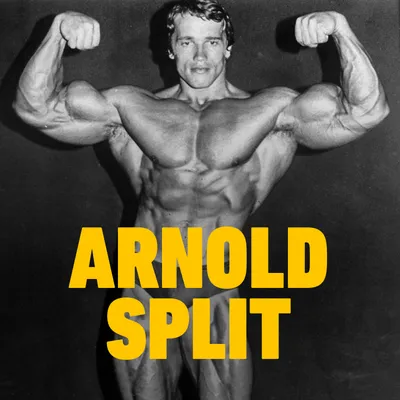
Arnold split, the 6-day bodybuilding split Arnold Schwarzenegger made famous: chest and back together, shoulders and arms together, then legs, each trained twice a week with Sunday off. Pairing opposing muscles lets you superset chest with back and biceps with triceps, and every muscle gets two hard sessions a week. Hardy tracks every set for you: log your reps, and the app raises or lowers your working weights automatically according to the rules below, so you never touch a spreadsheet.
Arnold split workout schedule
The Arnold workout split runs the three workouts twice each, in the order the book gives them:
- Monday and Thursday, Chest & Back: bench press supersetted with chin-ups, incline bench press supersetted with barbell rows, dumbbell pullover, deadlift, hanging leg raises
- Tuesday and Friday, Shoulders & Arms: overhead press, lateral raise, upright row, barbell curl supersetted with close-grip bench press, dumbbell curl supersetted with overhead triceps extension, hanging leg raises
- Wednesday and Saturday, Legs: squat, lunge, leg curl, calf raise, straight leg deadlift, hanging leg raises
- Sunday: rest
Supersetted exercises are paired in the routine: finish a set of the first, go straight to the second, then rest.
How this version differs from the book
The New Encyclopedia of Modern Bodybuilding gives this split as the Level I basic program, and its Level II regroups the same exercises into two workouts run three times a week rather than adding any. The book prescribes pyramid sets, 15, 10–12, 8–10 and 6 reps as the weight climbs; this routine uses 4 straight sets of 8–12 per exercise (3 sets of 6–10 on the deadlift, 4 sets of 12–15 on calves) so that progression is simple to track. Dropped from the book: the clean and press (an overhead press stands in), the push press, the wrist curls and reverse wrist curls, the good mornings, and the 10/6/4 "power" sets on the deadlift, upright row and straight leg deadlift. Changed: the book's 50 total chin-up reps become 4 sets of 8–12 with belt weight, standing calf raises go from 5 sets of 15 to 4 sets of 12–15, the barbell triceps extension is done with a dumbbell, and the daily crunches become hanging leg raises. Rest is about 90 seconds, longer than the book's "a minute or less". If you prefer pyramids, add weight and drop reps from set to set, and log what you lift.
Progression
Every weight exercise uses double progression. Start with a weight you can move for 8 clean reps on every set, add reps each session, and once every set reaches 12 Hardy adds weight (2.5 kg / 5 lb, or 1 kg / 2 lb on dumbbell exercises) and you drop back to 8. Miss the rep target on a set and the target drops by one rep next time; miss it at the bottom of the range and Hardy takes the same amount off. The hanging leg raises are bodyweight sets with no rule.
Tips
- Six days a week is a lot; if recovery lags, run each of the three workouts once a week with a day off between them.
- Chin-ups start at bodyweight; Hardy adds belt weight once every set reaches 12 reps.
- Sessions take 60–90 minutes with the supersets; run the pairs as straight sets and they take longer.
- Prefer fewer, harder sets? The Clark Kent Upper Lower Split uses two sets per exercise over four days.
Based on the Level I training program in The New Encyclopedia of Modern Bodybuilding by Arnold Schwarzenegger and Bill Dobbins. Not affiliated with Arnold Schwarzenegger or his products.
Starting TM is 90% of 1RM.
Targeted muscles
Workouts
Chest & Back
bench press
Set
Intensity
Weight
Reps
Rest time
Double Progression: Work within 8-12 reps, adding one rep per successful session. At the top of the range, weight increases by 5 lbs; failing at the bottom decreases it by 5 lbs.
bench press
4×8
chinup
Set
Intensity
Weight
Reps
Rest time
Double Progression: Work within 8-12 reps, adding one rep per successful session. At the top of the range, weight increases by 5 lbs; failing at the bottom decreases it by 5 lbs.
chinup
4×8
incline bench press
Set
Intensity
Weight
Reps
Rest time
Double Progression: Work within 8-12 reps, adding one rep per successful session. At the top of the range, weight increases by 5 lbs; failing at the bottom decreases it by 5 lbs.
incline bench press
4×8
barbell row
Set
Intensity
Weight
Reps
Rest time
Double Progression: Work within 8-12 reps, adding one rep per successful session. At the top of the range, weight increases by 5 lbs; failing at the bottom decreases it by 5 lbs.
barbell row
4×8
pullovers
Set
Intensity
Weight
Reps
Rest time
Double Progression: Work within 8-12 reps, adding one rep per successful session. At the top of the range, weight increases by 2 lbs; failing at the bottom decreases it by 2 lbs.
pullovers
4×8
deadlift
Set
Intensity
Weight
Reps
Rest time
Double Progression: Work within 6-10 reps, adding one rep per successful session. At the top of the range, weight increases by 5 lbs; failing at the bottom decreases it by 5 lbs.
deadlift
3×6
hanging leg raises
Set
Reps
Rest time
hanging leg raises
3×15
Shoulders & Arms
overhead press
Set
Intensity
Weight
Reps
Rest time
Double Progression: Work within 8-12 reps, adding one rep per successful session. At the top of the range, weight increases by 5 lbs; failing at the bottom decreases it by 5 lbs.
overhead press
4×8
lateral raise
Set
Intensity
Weight
Reps
Rest time
Double Progression: Work within 8-12 reps, adding one rep per successful session. At the top of the range, weight increases by 2 lbs; failing at the bottom decreases it by 2 lbs.
lateral raise
4×8
upright row
Set
Intensity
Weight
Reps
Rest time
Double Progression: Work within 8-12 reps, adding one rep per successful session. At the top of the range, weight increases by 5 lbs; failing at the bottom decreases it by 5 lbs.
upright row
4×8
curl
Set
Intensity
Weight
Reps
Rest time
Double Progression: Work within 8-12 reps, adding one rep per successful session. At the top of the range, weight increases by 5 lbs; failing at the bottom decreases it by 5 lbs.
curl
4×8
close-grip bench press
Set
Intensity
Weight
Reps
Rest time
Double Progression: Work within 8-12 reps, adding one rep per successful session. At the top of the range, weight increases by 5 lbs; failing at the bottom decreases it by 5 lbs.
close-grip bench press
4×8
curl
Set
Intensity
Weight
Reps
Rest time
Double Progression: Work within 8-12 reps, adding one rep per successful session. At the top of the range, weight increases by 2 lbs; failing at the bottom decreases it by 2 lbs.
curl
4×8
overhead triceps extensions
Set
Intensity
Weight
Reps
Rest time
Double Progression: Work within 8-12 reps, adding one rep per successful session. At the top of the range, weight increases by 2 lbs; failing at the bottom decreases it by 2 lbs.
overhead triceps extensions
4×8
hanging leg raises
Set
Reps
Rest time
hanging leg raises
3×15
Legs
squat
Set
Intensity
Weight
Reps
Rest time
Double Progression: Work within 8-12 reps, adding one rep per successful session. At the top of the range, weight increases by 5 lbs; failing at the bottom decreases it by 5 lbs.
squat
4×8
lunge
Set
Intensity
Weight
Reps
Rest time
Double Progression: Work within 8-12 reps, adding one rep per successful session. At the top of the range, weight increases by 2 lbs; failing at the bottom decreases it by 2 lbs.
lunge
4×8
leg curl
Set
Intensity
Weight
Reps
Rest time
Double Progression: Work within 8-12 reps, adding one rep per successful session. At the top of the range, weight increases by 5 lbs; failing at the bottom decreases it by 5 lbs.
leg curl
4×8
calf raise
Set
Intensity
Weight
Reps
Rest time
Double Progression: Work within 12-15 reps, adding one rep per successful session. At the top of the range, weight increases by 5 lbs; failing at the bottom decreases it by 5 lbs.
calf raise
4×12
straight leg deadlift
Set
Intensity
Weight
Reps
Rest time
Double Progression: Work within 8-12 reps, adding one rep per successful session. At the top of the range, weight increases by 5 lbs; failing at the bottom decreases it by 5 lbs.